Wednesday, May 22, 2013

An old rifle(man's) journey: From England to India and Wisconsin, via Pakistan and Afghanistan


As any amateur historian knows, you can have a great adventure without ever leaving your Barcalounger.  All it takes is a trip through your grandparents’ attic, an old steamer trunk stuffed with letters posted from long ago and far away, and a sense of wonder and curiosity.

Or, in my case, an old British-made Enfield No. 4 Mk. 1 rifle, some musty old records, the Internet, and a knowledgeable, observant gunsmith.

Before we begin this journey, please keep in mind that on a grand exploration like this, you have to be willing to ask a lot of questions based upon what you learn from your virtual travels … and you have to occasionally be satisfied with a dearth of definitive answers. 

It’s the exploring that’s fun .. not always the findings.

My virtual journey through military history began in 2012 with this old, beat-up – and thoroughly malfunctioning – British firearm.
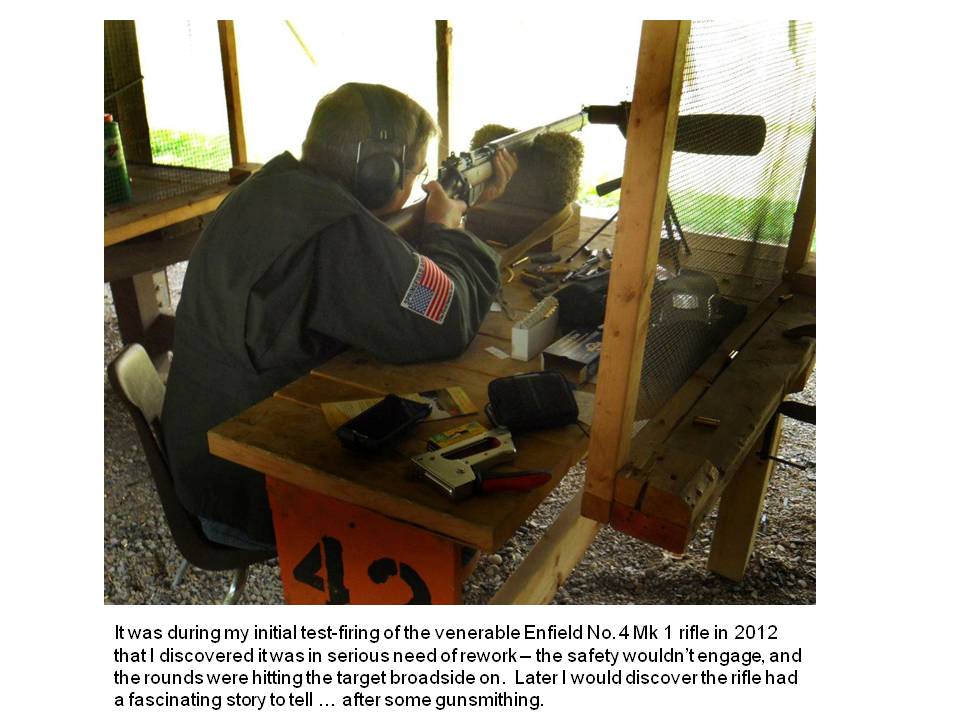


This rifle was manufactured in June of 1943 at the Royal Ordinance Factory Fazakerley, just outside of the city of Liverpool in the UK.  What would later be called World War II had been raging since 1939, and wasn’t going particularly well for the anyone but the Germans, Japanese and Italians.  America had only been in the war for a year, and fighting was heavy along the periphery of the Axis Powers.  From North Africa to Burma in the Far East and from the Coral Sea to Guadalcanal, Allied troops were just beginning to slowly grind the Axis advances to a bloody halt. 

But British troops and their allies from the far-flung nations of the British Empire had a particularly nasty problem besides an intractable enemy.

Two years previously, more than 330,000 members of the ill-starred British Expeditionary Force retreated from France before advancing German armies, and had to be rescued from the beaches of Dunkirk, France.  But in their haste to get to sea, the British and allies had to abandon all but a few of their individual weapons and all their vehicles and crew-served weapons.  That left the rebuilding British armies with a crying need for new weaponry, and not much time to design, test and build them.

Fortunately, the British Small Arms Factories at Enfield and Fazakerley were filled with master gunsmiths, designers and tinkerers, all of whom were geniuses at innovation and at building upon other’s work in short order.

The Short Magazine Lee Enfield rifle, first invented in 1895 and which had performed yeoman service in the trenches of World War I, was quickly redesigned to make the rifle simpler and easier to manufacture, simpler to maintain in the field, and devastating to any army coming up against it on the battlefield.  As one blogger put it, “This particular version was made in the largest quantities of any L-E and it provided sterling service in the trenches, not least because it was among the fastest operating bolt action rifles extant, as well as possessing the largest magazine capacity. The former was a result of its rear locking bolt, which shortened the bolt travel compared to front lug designs, as it simply has less bolt to withdraw before a new round can be stripped and fed, plus its very smooth internal machining.” 

The round it fired, the redoubtable .303 caliber firing a 174 grain bullet at 2.450 fps, was a rimmed, gently tapered case with a minimal shoulder.  While this mean easy feeding and extraction, especially in the tropical and sub-Saharan reaches of the Empire where its low operating pressure was an advantage, the round wasn't quite the ballistic thunderbolt that the German 8mm Mauser or the American 30-06 rounds were.  Who cares?  The rifle-and-round combination did devastating work in the hands of British soldiers.
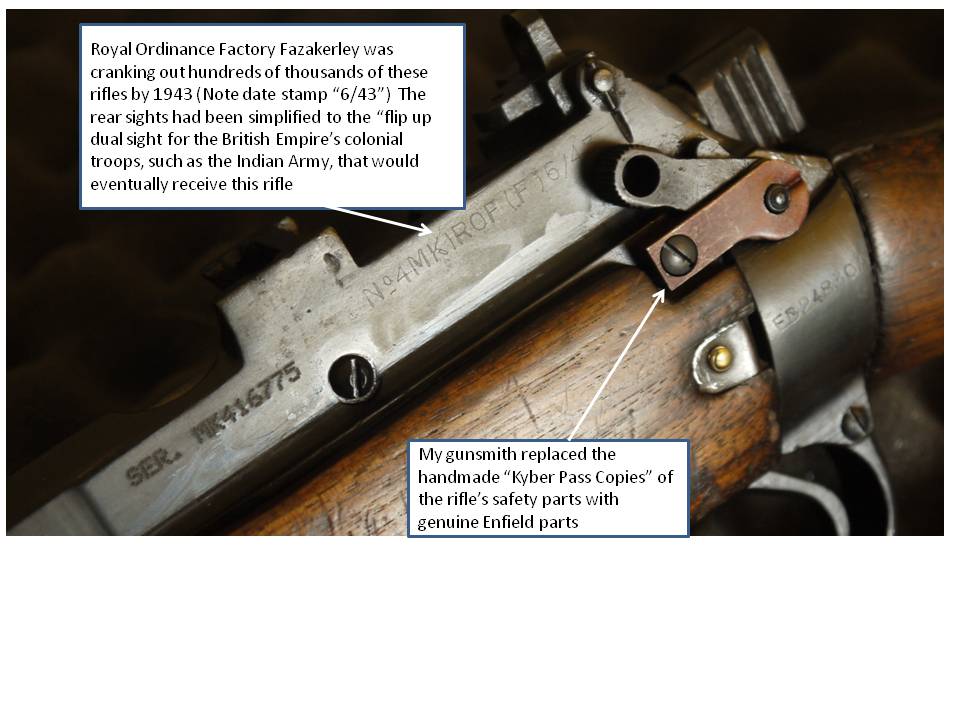

Records show that all the British small arms factories, Maltby, Enfield and Fazakerley -- as well as some in the U.S. and what would later become Pakistan -- got involved in making hundreds of thousands of these rifles as more and more troops from colonies of the British Empire were drafted into the fighting.  Colonial troops from Africa, The Caribbean and Central America, Southwest Asia and the Far East all were called upon to aid the British Empire as (perhaps unwilling, perhaps not) soldiers.  Whole shiploads of Enfield No. 4 Mk. 1 rifles were dispatched to arm these doughty troopers, more than 600,000 of them from Fazakerley alone. 

So it thus becomes easier to see how Indian and Pakistani troops got their hands on the Enfiels.  What is fascinating, however, is finding out about a few intermediate stops my rifle may have made after the war.  That's where master gunsmith Roger Williams of Northern Magnetic Gunsmithing (Fredonia, Wis.) comes in.

You see, I'm a fair marksman with just about any firearm.  I pick one up and it just "makes sense" to me.  Now mind you, I can no more calculate a ballistic trajectory than I could do some multi-billion-dollar corporation's tax return.  


But, when  I look down a rifle barrel, I can pretty much "will" the projectile to go where I want it to.


So, it was with no small amount of unwelcome surprise that, the first time I fired my weather-beaten old rifle, I had NO idea where the fired rounds were landing.   After firing off a full ten-round magazine, my target remained virgin white and unmarked.  I had to rely upon the "tracer method," spotting the dirt geysers on the berm behind the target stands and walking the bullets (finally) onto the paper.


When I walked downrange to eyeball my target, I saw keyhole-shaped holes in the paper instead of the neat, round cuts that a properly placed bullet makes.  (Not a good sign.)  When I tried to activate the safety mechanism and put the rifle down to scratch my head in wonder, the normally fine British-crafted safety lock refused to budge.


I laboriously unloaded the rifle, pulled out the bolt and looked down the barrel ... wincing at what I found there.  Where normally you would see a bright bore, its grooves spiraling aay like some sort of steel tunnel, I saw a large dark area about one-third of the way down where the barrel had bulged outward due to a badly loaded round exploding unevenly inside the chamber.


So I purchased a new(ish) Enfield barrel -- which was an adventure in itself -- and took the rifle to Roger-the-gunsmith.  That's where this got really interesting.


When he had the Enfield disassembled on his workbench, Roger noticed a distinct difference between the exquisite British craftsmanship in the old weapon, and those in the rifle's safety assembly.  Enfield craftsmanship is justly noted for its consistency and fine finish, while the many pins, locks, levers and springs that constituted the safety were coarse, gritty and barely fit their housings.


That, in itself, was the final clue as to the post-war whereabouts of my old rifle.


The border area around Peshawar, between Pakistan and Afghanistan, is famous for master craftsmen who -- given an original of anything from a toaster to an anti-tank gun -- can turn out an exact working copy using only elbow grease and the simplest of hand tools.


"Upon inspection," Roger wrote in his post-work report to me, "it can only be concluded that these parts were hand-made, probably during the Russo-Afghan War." 


The Internet is alive with eye witness reports of Taliban fighters swapping their once-beloved Kalashnikov AK-47s for the far older, more accurate Enfields, once the latter have been rebuilt in the gun shops of Peshawar.  And as warriors go, these Afridi, Pathan and Pashtun tribesmen would have as much use for a working safety mechanism as they would a turn signal.


Additionally, some enterprising tribesmen have been reported using old Enfields with wooden dowels shoved down the barrels.  The gunner attaches an old Soviet-era hand grenade to the sawed-off stick, and Voila -- a poor man's grenade launcher, albeit one that's as dangerous to the grenadier as it is to the enemy.


To fire this Rube Goldbergian grenade gun, the Afghan gunsmiths also had to pick up old spent brass cartridges lying around the battlefields, reload them with aged, second-rate gunpowder, and turn them into black cartridges.  But working without the modern digital scales and tools that modern reloaders rely upon for consistency and accuracy, it would have been easy to over-or-underload the gunpowder in a shell -- resulting in a rather spectacular failure (i.e., an explosion).


I speculate, and Roger agrees, that this is likely how the barrel came to be bulged in the first place.


As I mentioned earlier, this rifle's virtual journey leads us down a lot of interesting dead ends and blind alleys.  We trace it's travels as much "by Guess and by Gosh" as we do by consulting records of the British Imperial War Museums.


Nevertheless, records show that sometime in the mid-1990s, my old Enfield was found lying in a dusty warehouse in Pakistan, and came to the attention of Century Arms International, a U.S.-based arms importer.  As part of a huge consignment of similar Enfields, my rifle eventuall made its way to Mill's Fleet Farm store in Germantown, Wis., where I picked it up for a pittance and on a whim.

And now, after a year's worth of loving attention from Roger (much of that spent waiting for a parcel of new safety parts to arrive from the U.K.,) my old Enfield is an Enfield reborn.  But as much as I like refinishing old wood, I have decided not to install a new stock on this old warhorse.  As the salesman at the Fleet Farm store reminded me, "Each scratch and dent tells a story.  They're all part of this weapon's history."


When I was a graduate student at the US Naval War College, I wrote my Master's Thesis on how the Kalashnikov AK-47 became Africa's weapon of mass destruction -- how it's simple, rugged design coupled with devastating firepower enabled mostly illiterate fighters to face down the more heavily armed government troops they were up against.


But history shows that the Enfield No. 4 Mk. 1 rifle had a head start on the AK.


As one historian put it, "The Lee-Enfield influenced the ebb and flow of the geo-political landscape as did no other rifle of its time.  It helped the Afghans defeat the Soviet Army, and it can still be found serving as a police weapon in India and wielded by Afghan or Pakistani troops, a service life far in excess of any of its contemporaries."


And just picking up this magnificent old blunderbuss and taking it out to the rifle range gives me a direct connection to the young men who rewrote history with it.


An armchair adventure indeed.

Thursday, October 4, 2012

Lessons from the Littler Lives


Getting Ready for the Journey

My big, rangy, orange tomcat, Al, is preparing to leave me after 15 years of companionship and affection.

His diabetes has taken a turn for the worse, and he has been afflicted lately with seizures that wrack his whole body.  Worse yet, he’s stopped eating and drinking regularly … and I can tell he is lightening his load  in preparation for his long journey away.

I’m not sure he knows this.  I watch him stalk around the house, his collar bells still tinkling as he shakes his head.  Where once, his diabetes claimed all the strength in his hind legs, he has recovered much of his previous agility and strength.   If one didn’t know better, one might think Al was still planning on sticking around awhile longer.

Al is my friend and traveling companion.  When I was stationed elsewhere for a year, Kathy brought Al to me on one of her visits and he became my bachelor companion.  Every day I’d come home from work, he’d run up to me and sharpen his claws on my suede desert boots in greeting, while I brushed his fur.  At night, I’d sit on the couch and watch TV, and he’d sit on the back of the couch watching with me.  After awhile, he’d fall asleep up there, but not before reaching down and putting his paw on my shoulder.  I never wanted to move when he did that.  I never wanted to sever that connection between us.

Nowadays, when I come home and change out of my Best Buy work attire, I hear his tired meow coming from under the bedroom bench, and he slinks and stalks his way out onto the floor … demanding to be petted and brushed.

But the cat treats that used to send him into a tailspin now are left mostly untouched.  As I said, he’s preparing to leave.

                                                     *    *    *

At the same time, one of my two maniac ferrets, S’Mores, is winding his little life down after a two-year battle with cancer.    

These two little guys have brought much joy (and patches of floor poop, truth-be-told) into our lives.  They sleep 12-16 hours per day and wake up (ALWAYS in a great mood) and want to do nothing more than party with their people.  S’Mores used to delight friends and family with his thievery of stuffed animals – many much larger than he was – clamping them in his his tiny predator’s fangs and scampering away with them to his stash under the chair.  

Too, it seemed like he was also working as an experimental physicist, checking constantly to see if gravity was still in control.  (He would wriggle his way behind a row of books on a shelf, and push them out and off with his nose.  It seemed at first like we had a poltergeist, until we’d see his little face come poking out to find out where the book had gone.)

But his lymphoma now is getting ahead of his daily dose of chemo.  Despite daily hand-feedings and nightly doses of banana-flavored steroids, this little guy‘s once-glossy fur now is bare in patches, and his legs fail buckle under him while he eats.   

S’Mores, too, now is apparently nearing the end of his stay with us.

                                                   *    *    *

Cats, dogs, Guinea pigs, ferrets, hamsters, parakeets, goats, ponies and peacocks  … they've all come into the Breyfogle household over the years and have worked their way into our lives and hearts.  Each and every one gave unconditional love, affection and companionship, asking only that we feed and take care of them and spend a little time with them daily.

Each and every one has left a small hole when they inevitably passed away.

And that’s one of the first lessons from these little lives:  They go and you have to stay behind, grieving.
But if you've done it right, the memories of the joy they brought into your life more than make up for the brevity of their sojourn here.

So the companion animals in my life haven’t changed, really.  I've always known that cats and dogs and ferrets are relatively short-lived.

No, I fear that what may have changed is me.

Since I was diagnosed last year, I've felt the slow, gradual progress of the lung ailment that aims to claim me.  While I seldom think about it, watching my two little companions prepare for their final journey has made this Zen-like detachment of mine more difficult to maintain.

I've always told Kathy that I tend to live “…in the moment …” which has kept my disease far from my immediate attention.  The end is always an age away as the seemingly endless succession of “right now” and “this very moment” proceeds past. 

But as my disease advances – albeit slowly – I’m having a difficult time looking forward, especially since my two little friends are nearing their respective ends.  (sigh)

(Shaking it off ... sheepish grin)

OK … so that my friends and family won’t panic, I’m not succumbing to anything.  I've got a lot of fight and feistiness left in me. 

This sadness won’t get me for long, I promise.  I'm sure I can cajole Kathy and my family out of a toy or two.

And that’s another lesson from these little lives.  When there are caring humans around, there are always a few more treats to be had.

Sunday, September 30, 2012

The Old Dog can still bark pretty loud


I truly love my expensive, high-tech toys.  (Kathy will bear patient witness to this phenomenon.)

As I gaze over my rifle rack, my eye lights delightedly upon the SciFi-like Steyr USR, which looks just like a Star Wars blaster ought to look … shiny, long, swept-back and sleek.  My other 2nd Millennium toys are just as high-tech and post-Industrial-Revolution looking:  The FN P-90S is another of those weapons which have been featured on SciFi Channel shows (excuse me: SyFy Channel  … WTF?) … made of polymers and metal, and oddly shaped like a raygun probably will be in the not-too-distant future.  The DPMS Ar-15 looks just like the familiar, lethal workhorse it has become on the battlefields of Iraq and Afghanistan. 

They’re enough to make even the most ardent firearms antiquarian happy.

But, by God, there’s really something to be said for taking the Old Dogs out to the range and letting them bark.  And that’s just what I did on this glorious Fall day.

As I previously mentioned, the government-chartered Civilian Marksmanship Program (http://www.odcmp.com/) was founded in 1903 as part of the Defense Appropriations Act.  The stated intent was to better prepare American youth for military service in the event of callup, by training them early in the fine arts of marksmanship.  That organization has gone through a couple of RE-organizations since then, becoming a mostly-civilian run group.

But then, as today, one of the more popular parts of the program is allowing American citizens, who are not legally prohibited from doing so, to purchase military surplus rifles provided they belong to chartered clubs who oversee their members’ shooting activities.

I got my CMP M-1 Garand a couple of months ago, and it has been calling to me ever since … begging me to take it out to the range and let it play.  It was made in April, 1945, at the Springfield Armory, and stands as one of the best rifles I own … even if it’s so low-tech, it’s almost no-tech.

The Garand – called by Gen. George S. Patton “… the greatest battle implement ever devised …” – is no petite firearm.  In this age of lightweight polymer stocks and light metal actions, this rifle is a tank.   Where my AR-15 is a mere 6-7 lbs fully loaded, the M-1 – at 11.6 lbs – feels more like a sturdy artillery piece when shouldered. 

The wooden stock is polished and darkened from gunpowder and the sweat of multiple hands over the decades.  Some of the original bluing has worn off the gunmetal action.

But all these thoughts fade as the weapon snugs up against my shoulder and I reach inside myself in the familiar meditative ritual.  As I stare down the barrel at the target 100 yards distant, my eyes focus on the front sight.   As the hubbub of the range recedes,  the rifle’s rear sights, the target 100 yards away, and the rest of the world go blurry.  Where normally I’d feel the weight of the firearm in my hands, I instead feel  only the lazy beat of my own heart.  Instead of the loud kraaks from other shooters’ rifles, I hear my own muffled breathing as my inner noise quiets down.  It seemingly takes forever and no time at all, before the Garand’s loud report startles me out of my zone and the round is headed downrange.

Which is another thing to love about this old dog of a rifle.

I went shooting with my brother-in-law Drew Masters, while I was visiting on the East Coast recently.  Drew had recently obtained his own lever-action .30-30 rifle, and we headed out to a nearby range to pound some rounds downrange.  The .30-30 is such a light weapon, it has almost no mass at all to absorb what becomes a rather vicious kick.  Drew ended up the day with a large purple  “range hickey”  bruise on his right shoulder as a reward for his efforts.

While the Garand is a far more massive weapon, firing a bigger cartridge than the .30-30, its recoil is more of a powerful push than a kick.  With each round, your shoulder is physically moved rearwards for several inches.

I mean, with other of my older rifles, like my 1943 Mosin-Nagant, your shoulder moves so much that your new best friend after shooting is your chiropractor.  The Garand is nothing like that … you’re not hurting, even through you know you’ve been kissed.

Maybe it’s the feel of the gunpowder darkened wood stock under my hands, or the coppery tang of the cordite smell mixing with the gun oil.  Maybe it’s  the feel of a perfectly designed shoulder weapon… a weapon so perfectly designed it could only be improved by changing it completely into something else.  Maybe it’s  knowing that my father carried a rifle just like this one through the jungle hells of New Guinea.

Whatever. Could be any or all of these things

But on a sunny, warm Fall day, taking the Big Dog out and letting it play was perfect. 

Just perfect.


Tuesday, August 21, 2012

Memorandum for the Recond (continued): a Personal "Shopping List"


Committed to Memory (Part the Fourth) – Self assessment: It pays to advertise
I met Kathy, my loving wife, my adult supervision, and my very own “happily-ever-after,” through a singles ad ages ago.

Ever try and discuss yourself in one of those?

The responses I’ve seen run the entire spectrum from the teary-eyed woman who declared in her viral YouTube video that she wished she could hug all the kitty cats in the world; to a guy who sang his best Barry White impressions of what he would do to his would-be paramour into the video camera.

This wasn’t one of those ads.  This was an actual printed ad … in a real pre-Internet printed singles magazine.

So I knew I had basically once chance to impress the “… sweet, sexy, semi-artist …” whose ad caught my attention, and I had to get it right. (Query: Is a “Semi-artist” one who paints pictures solely of large, 18-wheeled vehicles?  Never have gotten a good answer to this question. But I digress.)

Lacking any Barry White ability (besides … this is a printed ad, remember?) and lacking any poetic abilities beyond things that rhyme with the word “Nantucket,” I elected to simply summarize myself in a rather long shopping list of attributes. (I know … typical “guy” response, right?)

But it worked.  Kathy tells me she wanted to meet that guy, even if our relationship never went anywhere afterwards. 

Aside from teaching me how to edit a list of bullet points (something that would stand me in good stead in the military, as I later prepared endless PowerPoint briefing slides,) writing that 7-page letter of “shopping lists” helped me to weigh and consider the person I had become.

And did I mention Kathy liked it, too?  We met for lunch at Beans and Barley, and started to talk.  We haven’t quit talking since then.  The rest, as they say, is history.

In the interests of full disclosure, I reprint that (edited) shopping list herewith.

Things I Like:
·        *  The “tick, tick, tick” sound my Trek Series 7200 mountain bike makes when I cycle down a country road, while the sun warms my back, and the miles whirl lazily by

·         * Stepping onto my elliptical machine, turning my IPod to 90’s music, turning the volume up to “stun’” and just stepping out hard and fast. Bliss!

·        *  Spicy food – I think that food (like Life) should be a little spicy and thus more memorable. I’ve always felt that life should be a little rough-edged and unfiltered … an attitude that has gotten me into trouble on more than one occasion.

·        *  An evening spent in the company of a small group of boon companions, with maybe a glass of bourbon or red wine to ease the conversation, while we talk of everything from politics to history to bullshit philosophies, to what we wanted to be when we grew up. (I always wanted to be an astronaut or a fire truck).

·        *  Telling and retelling sea stories (which strangely grow more epic in each recounting) to my grandchildren (after cleaning them up suitably for my wide-eyed, still-impressionable audience).

·        *  Reading. Reading anything … words in a row … cereal boxes if need be.

·        *  Sitting down at a computer terminal in a noisy newspaper newsroom, glancing at the clock to note that my deadline is just minutes away, taking a deep breath and reaching for the river of words that always flows through the back of my head.  As the minutes to deadline tick away, the adrenaline rush kicks in and the words just flow out of my fingertips into the computer keyboard and onto the monitor screen.  I grin to myself because I know I’m good at this and that the goddam’ story is gonna’ be brilliant  … and that tomorrow I’m going to have to do it all over again.  Of all the various and sundry jobs I’ve held over the years, from selling imported tropical fish and monkeys to operating a tollbooth, from  being a sailor to a dairy farm hired hand; being a newspaper reporter/photographer is right up there with being a Navy combat cameraman in my estimation.  Can’t remember ever having so much fun at work.

·        *  Becoming so involved in and transported by a novel that I actually come to care about the characters, and become impatient with the author (Are you listening, George R. R. Martin?) whose written output can’t keep up with my voracious reading

·        *  The intense bond between people in uniform that comes from shared hardship, danger and adversity...or sometimes just because we're all working for the same screaming T.I.U.  (Tool-In-Uniform), who gets away with it because he outranks us all.

·         * Sitting on the beach at night in Escanaba around a waning bonfire and “dreaming the coals,” as the evening winds down and the billions of stars and whirling satellites come out to dazzle us.

·         * Watching a pretty woman undress in the evening.

·         * Watching a pretty woman dress in the morning. (Not exactly raging hormones, but they’re there and fully functional, thank you.)

·         * A pot of freshly brewed coffee and a good cigar on a shady veranda

·        * Music – anything except “My Woman Done Left Me” hillbilly music … but especially the kind of music that batters you senseless with its power and majesty.  I can remember being in my High School orchestra when we played Handel’s Messiah.  The music swirled around us as we played … it was almost as though the air had turned to silver mist and you could almost see the arpeggios and scales as they whirled like silver dust devils through the thickened air around us.

·       *   The smiles that come with someone you’re connected to at the cellular level.  You need not finish each other’s sentences at that point, because you can hear the finish in your mind.  It’s as  though your DNA calls out to each other

·      *  Poetry, but the rather old-fashioned kind … the kind of poetry that stirs the blood and paints fiery pictures in your imagination.  Poets like Kipling and Masefield and Vachel Linday, whose works could almost be accompanied by stamping of feet or the beating of a regimental drum.

·       *  Time at the rifle range is almost like zen meditation to me.  You shoulder your rifle and gaze down the barrel at the front sight … letting the rest of the world go hazy.  You listen to your own breathing and slow it down to point where you can hear your breathing and hearbeat in your inner ear … and almost by itself, your hand begins a slow squ-e-e-e-e-e-ze of the trigger as you mentally reach out through the barrel to connect with the target a football field away.  When the rifle fires, it’s almost a surprise as the recoil pushes hard against your shoulder.  You let out the breath you forgot you were holding, and start all over again.  It’s as peaceful as naptime … punctuated by loud blasts from the rifle muzzle.

·      *    Animals – I’ve lived with and been owned by everything from peacocks to pygmy goats, guinea pigs to parakeets and ponies. I currently live with a rangy, orange tiger tomcat named “Al,” a clueless terrier named “Loki,” and two maniac little ferrets named “S’mores” and “Gadget.”  I find that animals give affection unreservedly, asking only that you take care of them in return.
   
      Things I don’t Like:

·       *  Politicians, who’ve never really served anything besides their own careers and bank accounts

·        *  Guys who treat their wives or girlfriends like they’re disposable or unimportant

·        *  Loud, boorish people who delight in throwing their weight around

·        *  Braggarts – how pathetic can you be?

·        *  Screamers

·       *  Those who’ve never served in uniform, but who feel compelled to lie and say they served with valor.

·        *  Peas, lima beans, liver

·        *  Non-alcoholic wine (what’s the point?)

·        * Parents who let their over-indulged, bratty children dominate their lives … and run around screaming in a public space (like Best Buy, for example)

·       *   Parents at the opposite end of the parenting spectrum who slap their children in public

·         * Having to go to the DMV.  Used to be, having to go to the dentist was attached to this same bullet point.  Lately, however, he’s started dosing me with really, REALLY happy pills before each visit.  Next, he lets me listen to really loud classical music on my Ipod while he’s at work.  I like my dentist now. DMV … are you paying attention?

Things I want to Remember:

·        *  Snorkeling near the Isla Taboga, off the coast of Panama.  The azure waters were warm and clear enough to put the best Swarovski crystals to shame.  Swimming through curtains of churning air bubbles, I emerge into a shaft of sunlight penetrating the waters like a spotlight.  In the middle of the dazzling brightness, a school of small squid were hovering in a long line like tiny, living, opalescent helicopters … the sunlight glinting off their parti-colored bodies, their fins moving sinuously as they kept station with each other in their underwater line.  I put out my hand to touch the nearest one, and like a sine wave on a screen, the line simply flowed around and away from my outstretched fingers.  Their huge eyes regarded me curiously as simply another denizen of the shallows.  Then, apparently reacting to a signal I was deaf to, the squid turned as one and sped off towards the deeper waters.  I looked around, seeing nothing to be alarmed at, but took my cue from them and turned back towards our boat.  A truly magic encounter.

·         * After 9/11, I was recalled to active duty and deployed to Guantanamo Bay Naval Base, in Cuba, where we were preparing Camp X-Ray for an expected influx of detainees captured on the battlefields of Afghanistan.  The first of what would be many Air Force flights touched down on the hot tarmac, and the massive rear doors of the aircraft opened.  Waiting military policemen walked on board, and walked off in pairs shortly thereafter, each pair with an orange jumpsuited detainee between them.  The prisoners, each many thousands of miles from their home base, looked around and spotted us watching.  The hate in their eyes was as palpable as the blast of heat from the tropical sun.  It occurred to me then that, these were the gentlemen who wished our country ill … and that I was glad to be there to see them safely taken off of the battlefield.

·      *  Sitting outside the Café Leopold Hawelka on a cobblestoned side street in Vienna.  I was sitting and reading the international edition of the Herald Tribune, and letting the empty Café Melange (Viennese coffee with thick cream and cinnamon) cups just pile up on the table.  I was in no hurry to get anywhere, and feeling especially worldly.

·        *  Sitting in a bar called the Green Parrot in the middle of a mangrove swamp on the island of Dominica.  The bar consisted of a few anchored platforms, with thatched roofs overhead, connected by a wobbly, floating wooden causeway.  (By the way, the parrot after whom the bar was named had long since passed away and the owner of the bar still grieved … and kept the empty cage hung over the array of rum bottles as a reminder.  Evidently, the parrot, whose name no one seemed to remember, got to pick the rum poured on any given day by pecking at the bottle.)  Bob Marley was blasting from the stereo, and a Rastafarian waiter named Keith was teaching us to play dominos.  A gentle rain – more of a misty spray actually – began falling and dripping through the thatched roof above us, and it was cooling and fine and simply wonderful.

·       *   Watching the ugly yellow-brown bar of a typhoon blow up over the horizon at sea, and start roaring towards my ship.  You know there’s nothing you can do about it, and that your day at sea is about to get “adventurous.”

·       *  Taking heavy seas aboard a small ship … you see dark, black water pile up and hammer down on your pitching decks … green water smash against the superstructure … and spray reach far up to soak the lookouts high above.  Just walking down a pitching, rolling passageway is a slow, torturous chore … and you grin to yourself because you know this is part of the adventure you signed up for.

·       *  Waking up on a ship at sea in the middle of the night, and feeling … feeling … the power of the ship vibrate right up through the deckplates, and feeling the rush of water along our hull as we plow through the heaving waves.

·         * Going to a family wedding at my relatives’ house in Mexico.  The father of the bride, my uncle Raoul, killed an ox and roasted it in a pit in the front yard of his house.  Only a few relatives were invited to the feast, but the entire village came anyway.  The bride and groom left after a few hours, but the party continued throughout the weekend.  I think someone stole my uncle’s knives and forks … but he couldn’t have cared less.  I think it was at this point that I began defining happiness less and less as owning fine things, and more and more as simply living life with gusto.

·        *  Making a difference in someone’s life.  By this point, I know I’ll never have a bridge or barracks named after me.  I know I’ll never be called the “…Father of Navy (insert random noun here…” or anything.  But I hope that the people I’ve come in regular contact with over the years will consider themselves helped along their path through my efforts.  It will have to do.

There were quite a few other items on the list as I recall ... but they were 'eyes-only for the "...sweet, sexy semi-artist ..." I was trying to meet.  I think I'll leave them that way.

Sunday, July 15, 2012

Gee, I wish I'd said that ...


25 phrases you wish you could say at work more often..

1. Ahhh...I see the fuck-up fairy has visited us again...

2. I don't know what your problem is, but I'll bet it's hard to pronounce.

3. How about never? Is never good for you?

4. I see you've set aside this special time to humiliate yourself in public.

5. I'm really easy to get along with once you people learn to worship me.

6. I'll try being nicer if you'll try being smarter.

7. I'm out of my mind, but feel free to leave a message...

8. I don't work here. I'm a consultant.

9. It sounds like English, but I can't understand a word you're saying.

10. I can see your point, but I still think you're full of shit.

11. I like you. You remind me of me when I was young and stupid.

12. You are validating my inherent mistrust of strangers.

13. I have plenty of talent and vision. I just don't give a damn.

14. I'm already visualizing the duct tape over your mouth.

15. I will always cherish the initial misconceptions I had about you.

16. Thank you. We're all refreshed and challenged by your unique point of view.

17. The fact that no one understands you doesn't mean you're an artist.

18. Any connection between your reality and mine is purely coincidental.

19. What am I? Flypaper for freaks!?

20. I'm not being rude. You're just insignificant.

21. It's a thankless job, but I've got a lot of Karma to burn off.

22. Yes, I am an agent of Satan, but my duties are largely ceremonial.

23. No, my powers can only be used for good.

24. You sound reasonable... Time to up the medication.

25. Who me? I just wander from room to room.

Friday, April 20, 2012

Memorandum for the Record (continued): My first real sea story


Committed to Memory (Part the Third):  “Mama! See the funny man?” “Hush, son, and you mustn’t stare.  He can’t help it.  He’s a lieutenant”

As a new sailor, I wanted to be just like my “sea daddies,” elder sailors each of whom had a whole raft of epic sea stories to tell as part of the education of a fresh-caught youngster.  One such sailor, an elderly First Class Photographer’s Mate named Jon Pfingsten, spun fascinating tale of himself and a very young Bosun’s Mate who (like me) wanted to be considered a true Fleet Sailor.

Jon coached him through the various steps, carefully upping the ante each time the young Bosun came back to him to get this apocryphal – some might say “mythical” – list checked off.

But it was what the mathematicians would call an “asymptotic” approach – the more the youngster achieved; the more Jon kept raising the bar.  The youngster never quite got there.

It was pretty much the same with me during my first few years … I never seemed to have anything “epic” to contribute to the daily bull sessions.  Somehow, sea stories always seemed to include other people.  Nothing I did ever seemed to have the “larger than life” quality that a good sea story requires.

                                            ***Now jump ahead several decades ***

As a seasoned (translation: semi-elderly) Lieutenant, I was part of a special detachment to board the Ticonderoga-class cruiser U.S.S. Vela Gulf, for fleet operations with our NATO partners up in the Baltic Sea, just off the coast of Sweden and Denmark. 

Here it must be noted that, even though the rank of “lieutenant” is a fairly junior officer rank, I had spent the previous 17 years coming up through the ranks of enlisted sailors, before taking a commission as an officer.  Thus, junior I might have been as officers go, but I already had gray hair and a former Chief Photographer’s Mate’s cynical attitude … and a penchant for voicing my opinions where other juniors might have opted for silence.

Officers like me – junior in rank but loudmouthed and opinionated – made a strange set of people who never really fit into the rigid hierarchy of the Naval Service.  So already, I stood apart from the other junior officers of our detachment aboard the ship.  I was a fairly elderly odd duck.

Back to the story.

The Baltic, as you might know, is a relatively shallow sea, but one which can blow up a truly noteworthy storm without much notice.  Thus it was on the last day of our fleet operations.  It had stormed the night before, so the air had that freshly scrubbed look to it, and the lightning-sparked scent of ozone still lent a coppery tang to the clear salty air.

The sea itself was azure blue, due in part to the white sands on the bottom only a few tens of feet below our keels, and also due to the reflected pure glory of the turquoise sky above.  It was going on towards an early autumn, and the wind had a chill to it that portended the long Scandinavian Winter to come, but today simply added a bracing coolness to the warm sun. 

Above, the sun shone through the racing scud clouds leftover from the storm, and painted everything with clarity and the definition one might expect of a laser-enhanced photograph. 
God’s own Photoshop, if you will.

I was all the way aft on the cruiser, and our battlegroup’s commander, Rear Admiral William “Mad Dog” Copeland (a Navy aviator, who rarely got the chance to play with surface ships) was up on the bridge, actually conning the ship.  Like all Navy jet pilots, he wanted to go fast, so he was putting our turbine-powered cruiser through her paces.  Each time he shifted the ship’s throttle, it produced a huge roostertail of white water from our madly spinning props, and a wake that sent the ships behind us surfing across the man-made waves.

Directly in our wake, the German destroyer Molders bobbed in and out of our wake.

She was a former U.S. Navy Charles F. Adams-class destroyer, of Post WWII design.  As such, she was the direct inheritor of everything that made a ship beautiful; long, lean, swept lines, knife-edged bow, menacing gun emplacements everywhere in place of the more modern (but far less beautiful) missile mounts that covered our ships.

In every motion and movement, she showed her classic “Greyhound of the Seas” heritage, taking the jumps and leaps through the waves like the thoroughbred she was.

She was a classic beauty: long, lean, gorgeous, agile, lethal.

That’s when the image of the too-beautiful day at sea hit me:  The perfect sky, the azure waves, the warm sun, the cool breeze, the freshly scrubbed atmosphere, a gorgeous ship knifing through the waves … this was an episode straight out of the 50’s TV show “Victory at Sea” … or better yet, it was a classic sea story … and it was all mine.

You ever have one of those perfect moments when you couldn’t do anything other than just grin like a maniac and laugh out loud at the utter perfection of it all?  This was one of those.
Standing back on the fantail of a warship, marveling at the timeless beauty of the scene before me, I started chuckling to myself and planning how I would turn it all into a sea story.  I mentally rehearsed my lines, chuckling with inner mirth at how it would all sound.    

Or at least, I thought it was “inner mirth.”

Other sailors, to whom I was still a mysterious cypher since I belonged to that odd “Who-were-those-guys?” detachment in their midst, turned at the sound of laughter and stared at the strange lieutenant (me), staring out to sea and talking and laughing to himself.

Their reaction set me off even more.  Chuckles gave way to guffaws of laughter at the pure joy of the moment.

The sailors glanced at each other and began moving away from me.  

Guffaws now started to double me over in paroxysms of uncontrolled laughter and tears of joy rolling down my cheeks.  (To this day, I’m reasonably sure I am referred to as “…that odd Lieutenant, who was talking to himself and laughing out loud at the voices in his head… and just who were those guys he was with, anyway?”)

I didn’t care a bit.  It was a beautiful moment, straight out of a postcard.
… or straight out of a sea story.

And now I’ve told my sea story to you.

Tuesday, April 10, 2012

Memorandum for the Record (Continued)

Committed to Memory (Part the Second)—“My God … It’s full of stars!”


Keir Dullea’s character in the iconic movie “2001: A Space Odyssey” uttered those words as an alien artifact transported him through fiery, acid-etched dimensions far from ordinary Human ken. Despite the drug-induced “enhancement” of our senses in the 1960s when I first saw that movie, one need not engage in any kind of chemical vacation to experience a truly mind-altering experience.

It happened to me at night, on the decks of a ship, far out at sea.

As soon as you open the ship’s watertight doors and go out onto the darkened weather decks, a blast of humid air almost knocks you off your feet and your senses begin to scream at you. You are, they insist, standing on the edge of a precipice that drops a lifetime away in every direction.

You see, a warship always switches to red interior illumination and darkens its outer decks at night. The red interior battle lanterns cast a blood-red glow about everything and – theoretically, at least -- enable you to save some of your night vision when you step outside. Black rubber sealed light traps about all exterior doors trap that same red light, keeping enemies from seeing a sudden glow of light and thus giving away your ship’s position. (We are told that the sudden flare of lighting a cigarette on deck at night can be seen by a lookout five miles away.)
Net result: As soon as you step out onto the weather decks of a ship at sea, you can HEAR the water rushing along the ship’s hull … and it sounds as though it’s only a few inches away from your outstretched hands … but you are blind, despite the red lanterns’ attempts at granting you night vision.

All about you is warm, humid, black, black, black … and the rush of damp air from your ship’s passage makes it feel as though the night itself were breathing into your face. You continue reaching blindly for the ship’s railing, as your senses continue to insist there’s nothing in front of you and you’re about to fall overboard into water that’s miles deep.

Finally, step by cautious step, your hands feel their way to the taught steel lifelines stretched all the way around the weather decks, and you cling to them, sidling your body the rest of the way and leaning into their solidity.
Then the magic show begins, as your night vision returns.

The deeper parts of the oceans are inhabited by tiny, unicellular creatures whose primary purposes are to (a) provide food for the food chain, and (b) start to glow brightly when they’re disturbed. Thus, when our ship rushes past, these tiny creatures begin to glow furiously, until the whole of the ocean around our hull seems to be luminous with witchfire. Further away from our hull, the creatures sparkle on and off, winking in some sort of glowing semaphore language at each other.

But that’s only the Overture to this magnificent symphony.
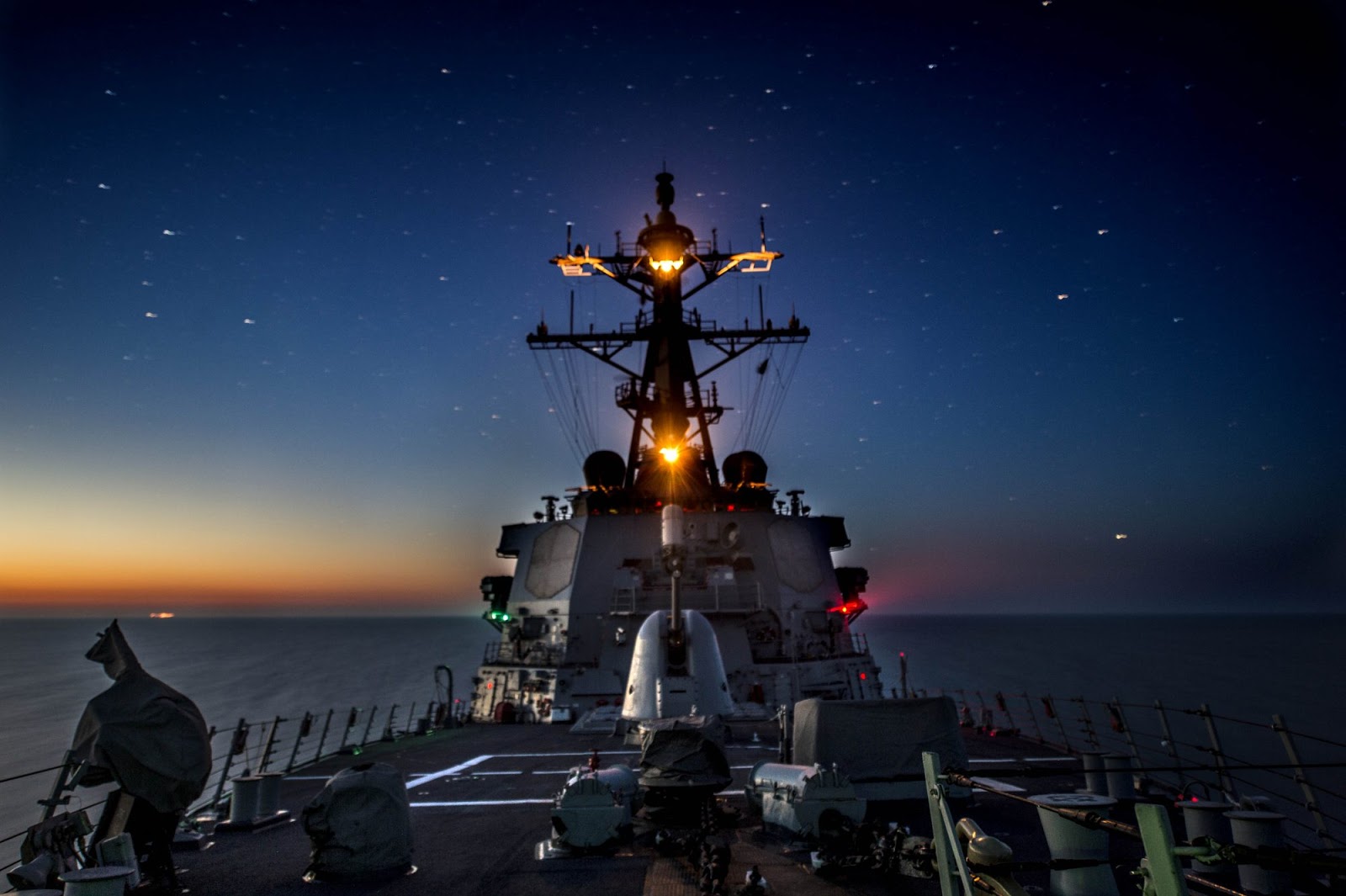
Far out at sea, the nearest land is several miles straight down beneath your keel, and the only light is that which comes straight from the Almighty’s paint brush. No light pollution out here to spoil the view, and your wondering eyes begin to realize exactly how vast is Creation and how tiny are all Human endeavors.
Because that’s when the stars start to come out.
First one tentative point of light appears above, then another, and another, until the stars and galaxies cascade into view in a kind of cosmic rush. All at once the sky – empty to your night blinded senses only a few moments before -- is a vast streak of light as the Milky Way burns its way across the sky, brighter than you’ve ever seen anything before. Familiar constellations are obscured and fade into the fiery background as millions and millions of unfamiliar stars come out of hiding.

That’s when you first notice that the majesty of the star show above is mirrored in the black water all around you. Winking fiery points above are reflected in the endless sea all around you.
Then you notice that the glowing little sea creatures outlining your ship’s hull are adding their own glowing counterpoint to the glory above and all around you.

All at once, it’s as though you’ve been floated bodily off your ship and now are suspended in a vast, glowing bowl of jewels … like you’ve been whisked away without realizing it and are floating somewhere near the Face of God itself.

Timeless.